 +91-9667229022| +91-9811604479

Blog
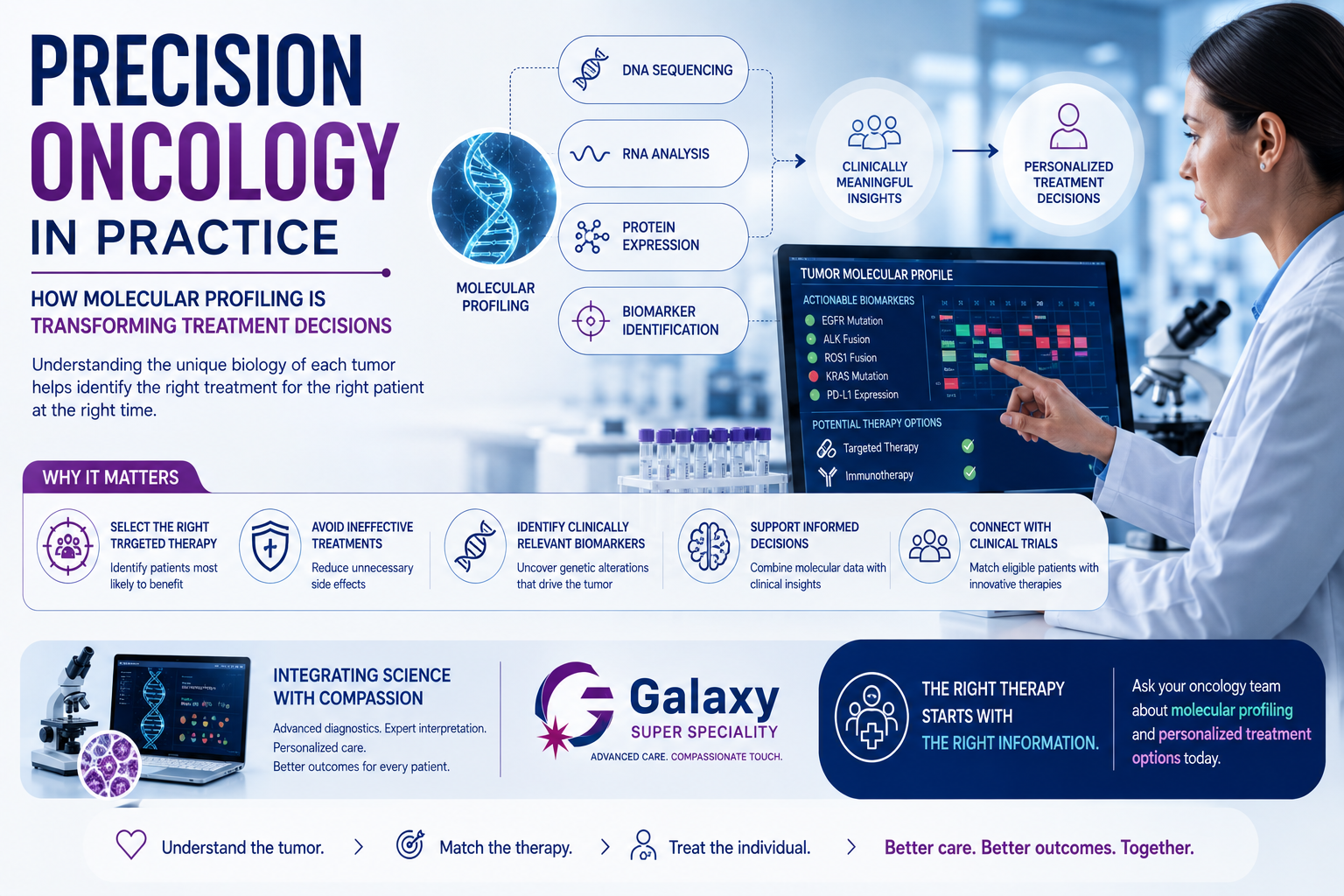
Molecular profiling can provide clinically relevant information to help guide personalized cancer treatment decisions
Cancer treatment is entering an increasingly personalized era—one where decisions are guided not only by where a cancer begins, but also by the biological characteristics that drive its growth.
Precision oncology uses information about a patient’s cancer, including molecular and biomarker information when appropriate, to help guide treatment decisions. Traditional factors such as cancer type, stage, pathology and overall health remain essential, while molecular profiling can provide an additional layer of information about the tumor.
The goal is not simply to collect more data. It is to identify clinically meaningful information that can help an oncology team make better-informed decisions for an individual patient.
What Is Precision Oncology?
Precision oncology is an approach to cancer care that considers the specific biological characteristics of a patient’s tumor when evaluating treatment options.
NCI describes precision medicine as an approach that takes into account individual differences in genes, environment and lifestyle when considering disease prevention and treatment. In cancer care, this can include examining molecular features of a tumor to help identify potentially relevant treatment options. (cancer.gov)
This does not mean that every patient receives a completely different treatment. Instead, it means that available clinical, pathological and molecular information can be integrated to determine which options may be most appropriate.
From One-Size-Fits-All to Treatment Built Around the Tumor
Cancer is not a single disease. Even tumors that originate in the same organ can have different molecular characteristics.
Traditional cancer classification remains extremely important. Doctors consider factors such as:
- Cancer type
- Stage
- Tumor location
- Pathology
- Grade
- Patient health
- Previous treatments
Molecular profiling can add another layer by examining characteristics such as DNA alterations, RNA changes, proteins or other biological features.
When relevant, this information can help clinicians understand the biology of a tumor and determine whether certain targeted therapies, immunotherapies or clinical trials could be considered.
What Is Molecular Profiling in Cancer?
Molecular profiling in cancer involves analyzing biological characteristics of a tumor to identify molecular alterations that may have clinical significance.
Depending on the cancer and the test, profiling may examine:
- Gene mutations
- Gene fusions
- Gene amplifications
- Protein expression
- DNA repair characteristics
- Tumor mutational features
- Other molecular biomarkers
Testing can involve tumor tissue or, in selected situations, blood-based approaches such as liquid biopsy.
The specific test should be selected based on the cancer type, clinical situation and questions the oncology team is trying to answer.
Turning Molecular Data Into Treatment Decisions
Molecular profiling becomes valuable when the information can influence a clinical decision.
For example, identifying a specific molecular alteration may indicate that a patient could be considered for a targeted therapy approved for cancers with that characteristic.
In other situations, biomarker information may help identify patients who could be candidates for particular immunotherapies or clinical trials.
NCI notes that biomarker testing can help doctors select treatments that may work best for certain cancers based on their molecular characteristics. (cancer.gov)
However, a molecular alteration does not automatically mean that a specific treatment will work.
Results must be interpreted in the context of the complete clinical picture.
Why Molecular Profiling Matters in Precision Oncology
The value of molecular profiling comes from connecting biological information with clinical decision-making.
Identifying Potentially Actionable Biomarkers
Some molecular alterations have established relationships with specific treatments. Identifying these alterations may help clinicians determine whether a targeted therapy could be appropriate.
Supporting Personalized Treatment
Molecular information can help distinguish between tumors that may look similar under traditional classification but have different biological characteristics.
Understanding Treatment Resistance
Cancer can evolve during treatment. Molecular testing may sometimes provide information about changes associated with treatment resistance and help clinicians consider alternative approaches.
Identifying Clinical Trial Opportunities
Some clinical trials use molecular characteristics to identify patients who may be eligible for investigational treatments or treatment combinations.
NCI’s precision-medicine resources describe clinical trials that match patients with therapies based on specific molecular characteristics. (cancer.gov)
Precision Oncology and Targeted Therapy
Targeted therapies are designed to interfere with specific molecules or biological pathways involved in cancer growth and survival.
Molecular profiling can help determine whether a tumor contains a characteristic that corresponds to a particular targeted treatment.
This creates a potential treatment pathway:
Profile → Identify → Match → Treat
But precision oncology is not simply about finding a mutation and prescribing a drug.
Doctors must consider whether the alteration is clinically meaningful, whether an approved treatment exists, whether the evidence supports its use and whether the treatment is appropriate for the individual patient.
The Role of Biomarker Testing
Biomarker testing is an important component of modern precision cancer care.
Depending on the cancer, testing may examine specific biomarkers that help guide treatment decisions. NCI notes that biomarker testing can be used to help select treatments, identify clinical trial opportunities and provide information about how a cancer may respond to certain therapies. (cancer.gov)
However, not every patient needs extensive molecular testing.
The usefulness of testing depends on the cancer type, stage, treatment options, available evidence and individual circumstances.
When Molecular Profiling May Be Considered
Molecular profiling may be particularly relevant when:
- A cancer has known molecularly targeted treatment options
- The cancer has progressed despite previous treatment
- A rare or unusual tumor is being evaluated
- A clinical trial requires a particular biomarker
- The oncology team needs additional information to evaluate treatment options
The decision should be made by the treating oncology team based on the patient’s clinical circumstances.
The Importance of Multidisciplinary Interpretation
A molecular report can contain a large amount of complex information.
A qualified oncology team may need to interpret molecular findings alongside:
- Pathology
- Imaging
- Cancer stage
- Clinical history
- Previous treatments
- Laboratory results
- Patient health
- Treatment goals
Molecular pathology and oncology expertise can therefore be important in determining whether a reported alteration has genuine clinical relevance.
This prevents molecular testing from becoming simply a search for mutations without a clear treatment purpose.
Limitations of Molecular Profiling
Although molecular profiling is an important advancement, it does not guarantee a treatment response.
Some tumors may have alterations for which there is no established treatment. A potentially actionable alteration may not always respond to the corresponding therapy. Cancer cells can also evolve and develop mechanisms of resistance.
Tumors may contain multiple cell populations with different molecular characteristics, adding further complexity.
For these reasons, molecular results should be considered one component of a broader treatment decision, not a replacement for clinical judgment.
The Future of Precision Oncology
As molecular technologies continue to evolve, precision oncology is becoming increasingly sophisticated.
Researchers are studying new biomarkers, molecular pathways, targeted therapies, immunotherapies and combination approaches.
Technologies that can analyze increasingly detailed molecular information may help clinicians better understand how individual cancers behave.
At the same time, researchers are working to determine which molecular findings actually translate into meaningful improvements in patient outcomes.
The future is therefore not simply about generating more molecular data.
It is about transforming that data into reliable, clinically useful decisions.
Precision Oncology at Galaxy Super Speciality
At Galaxy Super Speciality, our approach to advanced cancer care combines specialist oncology expertise, appropriate diagnostic evaluation, evidence-based treatment and individualized care planning.
For selected patients, molecular or biomarker testing may provide clinically relevant information that can help the oncology team evaluate treatment options.
Whether testing is appropriate depends on the cancer type, stage, previous treatment, clinical findings and available treatment options.
A specialist consultation can help patients understand whether molecular profiling could be relevant to their individual situation.
Take the Next Step Toward Smarter Cancer Care
If you or your loved one has been diagnosed with cancer, ask your oncology team whether molecular profiling or biomarker testing could provide useful information for treatment planning.
Discuss the potential benefits, limitations and implications of testing with a qualified healthcare professional before making treatment decisions.
At Galaxy Super Speciality, we believe understanding the biology of a cancer can help support more informed conversations about treatment.
Because in precision oncology, understanding the tumor is an important step toward treating the individual.
Frequently Asked Questions
What is precision oncology?
Precision oncology is an approach to cancer care that uses information about a patient’s tumor and other individual characteristics to help guide prevention, diagnosis or treatment decisions. (cancer.gov)
What is molecular profiling in cancer?
Molecular profiling analyzes genetic, molecular or biological characteristics of a tumor to identify alterations or biomarkers that may have clinical relevance.
Can molecular profiling determine the best cancer treatment?
It can provide information that may help guide treatment selection, but it does not independently determine the best treatment. Doctors consider molecular findings alongside cancer type, stage, pathology, previous treatment, overall health and other factors.
Does every cancer patient need molecular profiling?
No. The usefulness of molecular testing varies according to cancer type, stage, treatment options and individual clinical circumstances.
Can molecular profiling identify targeted therapies?
In appropriate cases, molecular testing can identify biomarkers associated with specific targeted therapies. However, the presence of a biomarker does not guarantee that the treatment will be effective. (cancer.gov)
Can molecular testing help when cancer becomes resistant to treatment?
In some situations, repeat molecular testing may identify changes that have emerged during treatment and could provide additional information for treatment planning. Whether repeat testing is appropriate depends on the cancer and clinical circumstances.
Is precision oncology the same as personalized medicine?
The terms are closely related but can have different scopes. Precision oncology generally focuses on using biological and molecular information to guide cancer care, while personalized medicine can encompass a broader range of individual factors.
Conclusion
Cancer treatment is moving toward a more detailed understanding of tumor biology.
Precision oncology combines traditional clinical information with molecular and biomarker insights when appropriate, helping oncology teams explore treatment options that may be better aligned with the characteristics of an individual patient’s cancer.
Molecular profiling is not a guarantee of treatment success, but it can provide valuable information when used appropriately and interpreted by experienced healthcare professionals.
The future of cancer care is not simply about treating the tumor. It is about understanding the tumor—and using that understanding to make better-informed decisions for the individual patient.